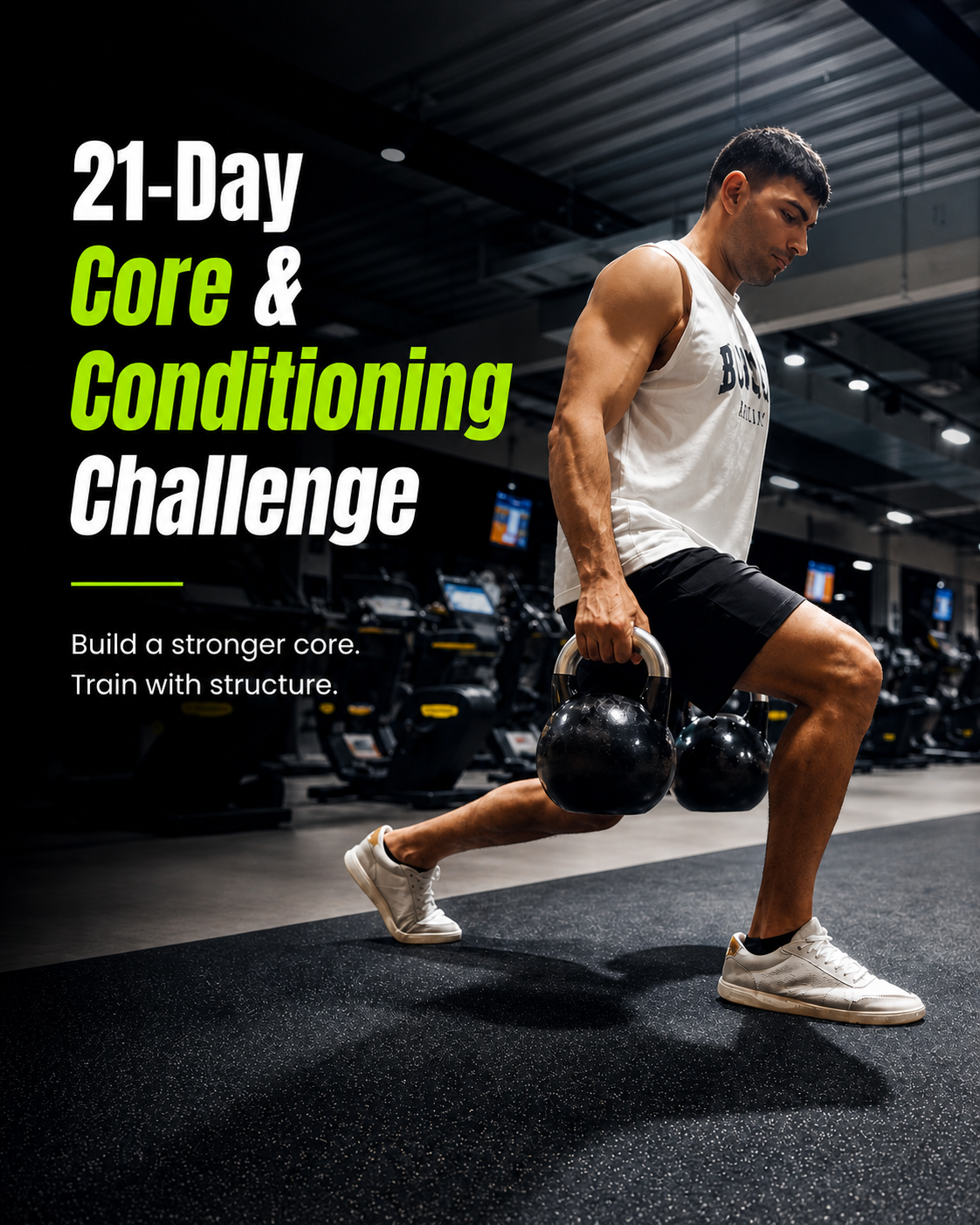
21-Day Core Challenge: Can You Really Build a Stronger Core?
No magic. No fake promises. Just training, consistency and a smarter plan.
By Ivan Marinov | Personal Trainer & Athletic Coach | FitRefect
Can 21 days completely transform your body? No. Can they change the direction of your training? Absolutely.
The internet loves 21-day promises: visible abs, perfect habits and a completely new body. Apparently, three weeks is enough to rebuild your core, reorganize your life and possibly become the person who enjoys meal prepping on Sunday night.
Your body, unfortunately, does not follow a marketing calendar.
Twenty-one days will not magically remove abdominal fat or turn every workout into an athletic breakthrough. But a well-structured 21-day challenge can still be valuable. It can give you a clear starting point, help you practise important movement patterns, improve your ability to control your trunk and replace random workouts with a system you can actually follow.
That distinction matters. CORE-21 was not created as a shortcut to a six-pack. It was created as a structured beginning: home and gym training options, video guidance, progress tracking and coaching support inside the FitRefect ecosystem.
Your Core Is More Than Your Abs
When most people hear the word core, they immediately think about the rectus abdominis, the muscle responsible for the familiar six-pack appearance. That muscle is part of the core, but it is not working alone.
In practical training terms, the core includes the muscles surrounding the trunk, pelvis, hips and lower back. These muscles work together to create movement, resist unwanted movement, stabilize the spine and pelvis, and transfer force between the upper and lower body. Every time you carry something heavy, change direction, perform a squat or simply try not to collapse during a plank, your core is involved.
Your core is a team, not one abdominal muscle trying to become famous on Instagram.
This is why effective core training should not consist only of hundreds of crunches. A complete approach can include resisting extension, rotation and lateral flexion, as well as controlled flexion, extension and loaded movement. Planks, dead bugs, carries, cable exercises and appropriately progressed bodyweight movements can all have a place, depending on the person’s ability and goal.
What Does the Research Say About Core Training?
A 2023 systematic review and meta-analysis by Angela Rodriguez-Perea and colleagues examined the effects of core training on balance, jumping, and throwing or hitting performance in healthy participants. The researchers identified 3,223 records, included 22 studies in the systematic review and used 21 in the meta-analysis. The training interventions lasted at least four weeks.
The clearest result was an improvement in balance. The analysis also reported improvements in vertical and horizontal jumping and in throwing or hitting distance. Throwing or hitting velocity, however, did not show a statistically significant improvement. In other words, core training can support several physical qualities, but it does not automatically make every athlete faster, stronger and more technically skilled.
A broader 2025 meta-analysis by Tongwu Yu and colleagues reached a similar but more cautious conclusion. It included 29 randomized studies and 956 athletes between 15 and 23 years of age. Core training improved general athletic performance, especially core endurance and balance. However, the overall effect on sport-specific performance was not statistically significant, and the results varied greatly between studies.
Translation: a stronger foundation can help, but a plank does not replace sprinting, jumping practice, sport-specific skills or full-body strength training.
These studies support the inclusion of core work within a complete training program. They do not prove that one particular core challenge will improve every possible outcome, and they do not specifically validate a 21-day duration. In fact, the 2023 review only included interventions lasting four weeks or longer. That limitation should be stated honestly.
Consistency Beats Complexity
The American College of Sports Medicine published an updated Position Stand in 2026 after synthesizing 137 systematic reviews representing more than 30,000 participants. Its central message was refreshingly simple: regular resistance training matters more than chasing a needlessly complicated perfect program.
For most healthy adults, the ACSM recommends training all major muscle groups at least twice per week with meaningful effort. Programs can then be adjusted according to the goal. Heavier loads can emphasize maximal strength, higher weekly volume can support muscle growth, and faster concentric actions with appropriate loads can develop power.
The ACSM also noted that barbells and gym machines are not mandatory. Bodyweight exercises, resistance bands and home-based routines can improve strength, muscle size and physical function. This matters for CORE-21 because the training environment should not decide whether someone can participate. Home and gym versions can follow the same training principles while using different tools.
Your muscles do not know whether an exercise came from an expensive machine or your living-room floor. They respond to effort, progression and repetition.
Advanced techniques can be useful in specific situations, but they are not compulsory for the average trainee. Training to complete muscular failure, changing exercises constantly and building a program complicated enough to require air-traffic control are not prerequisites for progress.
Can You Build a Stronger Core in 21 Days?
A truthful answer is: you can start building one.
Three weeks provide repeated opportunities to practise bracing, breathing, body control and several core movement patterns. A beginner may notice better exercise technique, greater confidence, improved tolerance and the ability to perform more controlled work. Someone already well trained may experience smaller or less obvious changes.
The size of any improvement depends on training experience, exercise selection, difficulty, recovery, nutrition, sleep and individual response. Because the available meta-analyses generally examine programs lasting at least four weeks, we should not use them as proof that every participant will achieve a measurable transformation by day 21.
What 21 days can provide is structure. Instead of opening social media and choosing whichever abdominal exercise looks most painful, you know what comes next, how the exercise should be performed and how the work develops over time.
Will Core Training Burn Belly Fat?
This is where fitness marketing often becomes more flexible than human physiology.
In a small randomized study published in 2011, Sachin Vispute and colleagues assigned 24 sedentary adults either to an abdominal-exercise group or a control group. The exercise group completed seven abdominal exercises, two sets of ten repetitions, five days per week for six weeks.
The participants improved their abdominal muscular endurance. They did not show significant reductions in body weight, total body-fat percentage, abdominal fat, waist circumference or abdominal skinfold measurements. The study was small, so it should not be treated as the final word on every possible program, but it clearly demonstrates that training the abdominal muscles and losing the fat above them are different outcomes.
A plank can train your core. It cannot negotiate directly with the fat covering it.
Some newer research has reopened discussion about whether local muscular work can slightly influence regional fat use under particular conditions. That question is scientifically interesting, but the evidence is not strong or consistent enough to promise reliable spot reduction. Visible abdominal definition still depends heavily on overall body-fat levels, nutrition, total activity, genetics and the development of the abdominal muscles themselves.
CORE-21 can support a broader body-composition goal by adding structured activity and helping users train consistently. It should not be advertised as a method that selectively removes belly fat.
Does a Habit Really Take 21 Days?
The idea that a habit is permanently formed after exactly 21 days is one of those statements that has been repeated so often that it eventually started wearing a lab coat.
A 2024 systematic review and meta-analysis by Ben Singh and colleagues examined 20 studies with 2,601 participants. The reported median time for health-related habits to develop ranged from 59 to 66 days, while reported means ranged from 106 to 154 days. Individual estimates varied enormously, from 4 to 335 days. The authors also noted that many included studies had a high risk of bias, so even these numbers should not be treated as a universal deadline.
Day 21 is not a graduation ceremony where your brain hands you a permanent habit certificate.
That does not make a 21-day challenge useless. It simply changes its purpose. Twenty-one days can reduce uncertainty, create repeated practice and help someone discover a routine that fits their life. The challenge can begin the habit-building process, but maintaining the behaviour after the challenge is what turns a temporary effort into a lasting pattern.
What a Smart 21-Day Core Challenge Should Include
A useful challenge should offer more than a countdown and a different random exercise every day. It should have a clear starting point, appropriate exercise variations and a way to progress without sacrificing technique.
Movement variety matters. The program should train the core to resist and control movement in several directions instead of relying only on repeated spinal flexion. Difficulty should also match the participant. A beginner who cannot maintain position during a basic dead bug does not need a more dramatic exercise; that person needs an exercise that can be performed well and progressed gradually.
Progression does not always mean adding weight. It can mean improving control, increasing repetitions, extending a hold, using a longer lever, reducing external support or moving to a more demanding variation. Progress should be earned, not selected because the next video looks exciting.
Recovery belongs in the plan too. The core muscles respond to training and fatigue like other muscles. More work is not automatically better work, and discomfort is not a reliable score for effectiveness.
Why I Created CORE-21
As a personal trainer, I repeatedly see the same problem: people are willing to work, but they do not have a clear system. They collect exercises from different videos, change their routine before it has time to work and have no simple way to record progress.
That is why I created CORE-21 within FitRefect. It is not a playlist of random ab exercises and it is not a promise of a new body in three weeks. It is a structured 21-day starting point built around guided training, progression and accountability.
Participants can choose home or gym options after purchase, follow video guidance, use FitRefect tools to monitor their training and access private coaching support. The purpose is to remove guesswork and make the next step clear.
CORE-21 does not promise magic. It gives you something more useful: a plan you can actually follow.
Who Is CORE-21 For?
CORE-21 is designed for people who want a clearer and more consistent approach to core and conditioning training. It can suit beginners who need guidance and more experienced trainees who want a focused block alongside their wider training.
It is not medical treatment. Anyone with persistent or severe pain, a recent injury or operation, pregnancy or postpartum considerations, or a diagnosed spinal or health condition should obtain appropriate professional guidance before beginning a new exercise program. Stop an exercise if it produces sharp or radiating pain, numbness, unusual weakness or other concerning symptoms.
The Honest Conclusion
Core training works, but the realistic benefits are more interesting than the exaggerated promises. Research supports improvements in qualities such as core endurance and balance, with possible benefits for certain performance measures. The effect on sport-specific performance varies, and abdominal exercise alone is not a dependable strategy for removing belly fat.
Twenty-one days are not a biological finish line, and they are usually not enough to make a behaviour permanently automatic. They can, however, be enough to stop guessing, begin practising consistently and establish a foundation for what comes next.
The best challenge is not the one that leaves you exhausted for a week and forgotten by the next month. It is the one that teaches you how to continue.
Ready to stop training randomly? Start CORE-21 with Home and Gym options, video guidance, progress tracking and coaching support.
START CORE-21
References
Editorial Note
This article is educational and is intended for generally healthy adults. It is not medical advice, diagnosis or treatment. Scientific evidence supports principles and population-level findings; it does not constitute a clinical validation of the specific CORE-21 product. The information presented herein aims to enhance the understanding of health-related concepts among individuals who are generally in good health. It is imperative to recognize that while the data referenced is grounded in scientific research and population studies, it should not be interpreted as a substitute for professional medical guidance. Individuals are encouraged to consult healthcare professionals for personalized advice tailored to their specific health circumstances. Furthermore, the principles discussed herein may vary in applicability based on individual health profiles and conditions. Thus, while this article serves to inform, it is not designed to serve as a definitive resource for diagnosis or therapeutic interventions.
DOWNLOAD OUR APP TODAY!